

Fourth-Party Risk: The Hidden Threat in Modern Vendor Ecosystems
Most organizations today have mature third-party risk management (TPRM) programs. Vendor onboarding, security assessments, and compliance reviews are now standard practice.
Yet despite this progress, major cyber disruptions continue to occur—and increasingly, they originate from a place many organizations fail to see.
Vendors behind your vendors.
This is the reality of fourth-party risk—a growing challenge that traditional risk frameworks are not designed to handle.
The Reality: Risk Extends Beyond Direct Vendors

Organizations have invested heavily in managing direct vendor relationships. But those vendors rely on their own ecosystem of providers, platforms, and subcontractors.
When one of these downstream providers fails, the impact doesn’t stop there—it cascades upward.
The biggest disruptions today are no longer coming from direct vendors, but from dependencies that exist beyond visibility and control.
This creates a critical blind spot in modern cybersecurity strategies.
What Is Fourth-Party Risk?

Fourth-party risk refers to the exposure created by the suppliers and services used by your vendors.
While you may govern your direct vendors, they depend on:
Cloud infrastructure providers
Identity and authentication services
SaaS platforms
Subcontractors
Software components and libraries
These entities form your extended supply chain. They are often invisible—but their impact is anything but.
Why Fourth-Party Risk Is Fundamentally Different

Fourth-party risk is not just an extension of vendor management—it is a different category of risk altogether.
It introduces shared dependency risk, where multiple organizations rely on the same underlying services.
This creates scenarios where:
A single cloud outage disrupts multiple platforms
A compromised identity provider exposes access across systems
A vulnerable software component impacts entire ecosystems
One failure can propagate across multiple services simultaneously.
This is not a vendor issue—it is an ecosystem risk problem.
The Contract Gap: Where Control Breaks Down

With third-party vendors, organizations can define expectations through contracts, SLAs, and compliance requirements.
But with fourth parties, this control disappears.
You can contract with third parties
You cannot contract with most fourth parties
Instead, you rely on your vendor to manage those relationships—and their priorities may not align with your risk tolerance.
This creates a structural gap in governance.
When Security Incidents Become Business Failures

Fourth-party incidents rarely stay technical.
When a downstream provider fails, the consequences quickly escalate into business-level impact:
Service outages
SLA violations
Regulatory exposure
Loss of customer trust
Even if the root cause lies outside your organization, accountability still lands with you.
The Problem With Point-in-Time Assessments

Most vendor risk programs rely on periodic reviews:
Annual assessments
SOC reports
Scheduled audits
While useful, these provide only a snapshot in time.
In reality, fourth-party exposure changes continuously as vendors:
Add new subcontractors
Shift infrastructure
Introduce new components
Migrate architectures
A static model cannot track a dynamic ecosystem.
Continuous Monitoring Is No Longer Optional
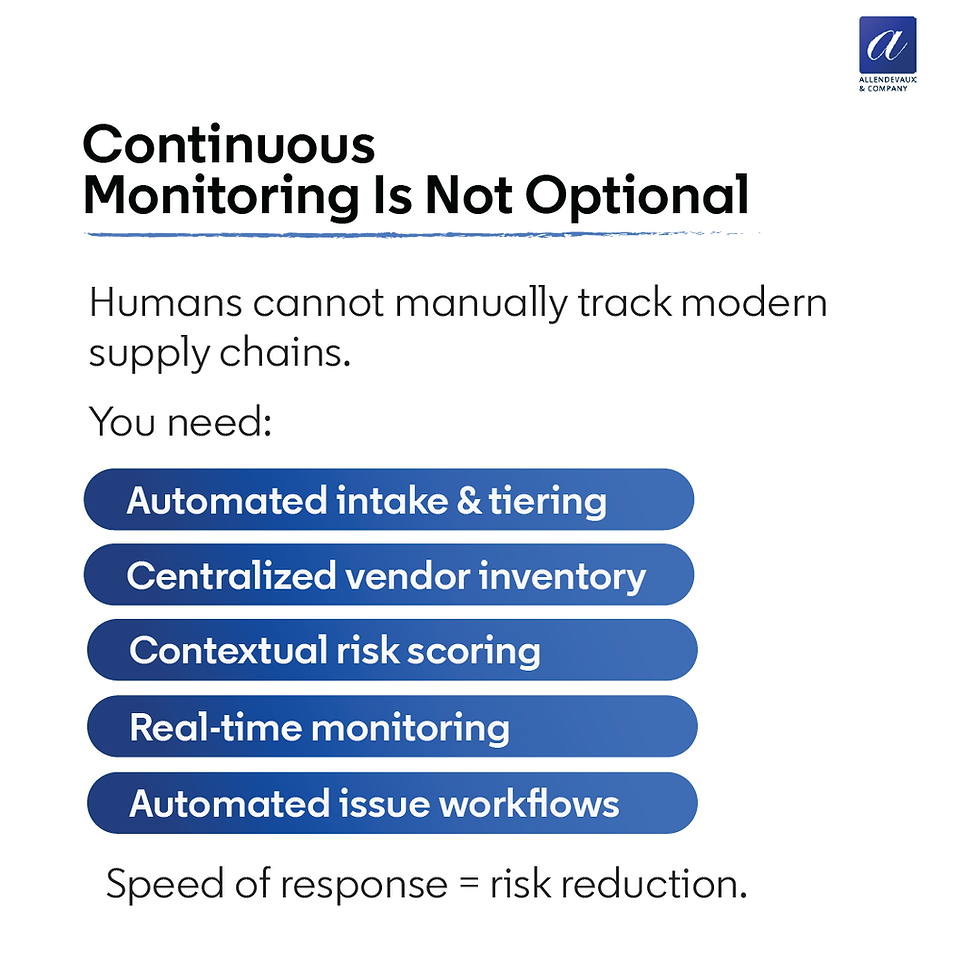
Modern supply chains are too complex for manual oversight.
Organizations must move toward continuous visibility and automated risk management, including:
Automated vendor intake and classification
Centralized vendor inventory
Contextual risk scoring across dependencies
Real-time monitoring of changes and threats
Automated workflows for issue resolution
Speed of response directly reduces risk.
The Shift From Compliance to Operational Resilience

Fourth-party risk changes the purpose of vendor risk management.
It is no longer about:
Completing questionnaires
Passing audits
Maintaining documentation
Instead, it becomes about operational resilience—the ability to continue functioning when disruptions occur.
Organizations must develop the capability to:
Map dependency exposure
Identify shared risk concentrations
Respond quickly in the first critical hours of an incident
Final Insight: Fourth-Party Risk Is the Default State of Digital Business
Modern digital ecosystems are deeply interconnected. Cloud platforms, SaaS tools, identity providers, and software components are shared across thousands of organizations.
This means one thing:
Fourth-party risk is no longer niche—it is the default state of digital business.
Continuous visibility is how governance catches up with reality.
Organizations that recognize this shift early will be better equipped to manage risk, maintain resilience, and protect trust in an increasingly interconnected world.


Comments