

Cybersecurity Trends 2026: Emerging Threats Every Business Must Prepare For
Cybersecurity is entering a new era.
Attack volumes are rising, connected devices are creating new vulnerabilities, smaller businesses remain under-protected, and future technologies like quantum computing are already forcing organizations to rethink long-term security strategies.
Individually, these trends are concerning.
Together, they paint a much bigger picture:
The cybersecurity challenge is no longer about isolated threats—it is about managing an increasingly interconnected risk ecosystem.
India Is Facing an Unprecedented Surge in Cyberattacks

The cyber threat landscape in India continues to intensify.
Recent data shows that organizations in India experience an average of 3,195 cyberattacks per week, making the country one of the most targeted regions globally. This figure is approximately 62% higher than the global average. Additionally, ransomware attacks against the education sector continue to rise.
This trend reflects a significant shift.
India’s rapid digital transformation has created tremendous opportunities, but it has also expanded the attack surface dramatically.
As organizations accelerate cloud adoption, digital services, and AI initiatives, attackers are finding more opportunities to exploit vulnerabilities.
The question is no longer whether organizations will face attacks.
It’s whether they are prepared to withstand them.
IoT Devices Are Becoming the Weakest Link

The growth of connected devices is introducing another major security challenge.
Research indicates that more than 50% of IoT devices contain critical vulnerabilities that attackers can exploit almost immediately.
Even more concerning:
Over 75% of IoT-related cyberattacks target routers, making them one of the largest and most attractive attack vectors in modern environments.
IoT adoption has outpaced security maturity.
Organizations now manage thousands of connected endpoints, including:
Smart devices
Industrial systems
Medical equipment
Sensors and monitoring devices
Smart office infrastructure
Every connected device increases convenience.
But every connected device also expands the organization’s attack surface.
Smaller Organizations Remain Significantly Underserved

One of the most overlooked issues in cybersecurity is the protection gap affecting smaller organizations.
According to recent findings:
34% of organizations provide formal cybersecurity support to smaller businesses.
31% offer informal or ad-hoc guidance.
35% provide no support at all.
While approximately 65% of organizations offer some form of assistance, a significant portion of smaller businesses continue to operate without adequate security guidance.
This matters because attackers increasingly target smaller organizations precisely because they often lack:
Dedicated security teams
Mature governance frameworks
Financial resources for advanced defenses
Continuous monitoring capabilities
Cybersecurity resilience is increasingly becoming a collective challenge.
Weaknesses within one organization often become risks for entire ecosystems.
The Next Security Race Has Already Started
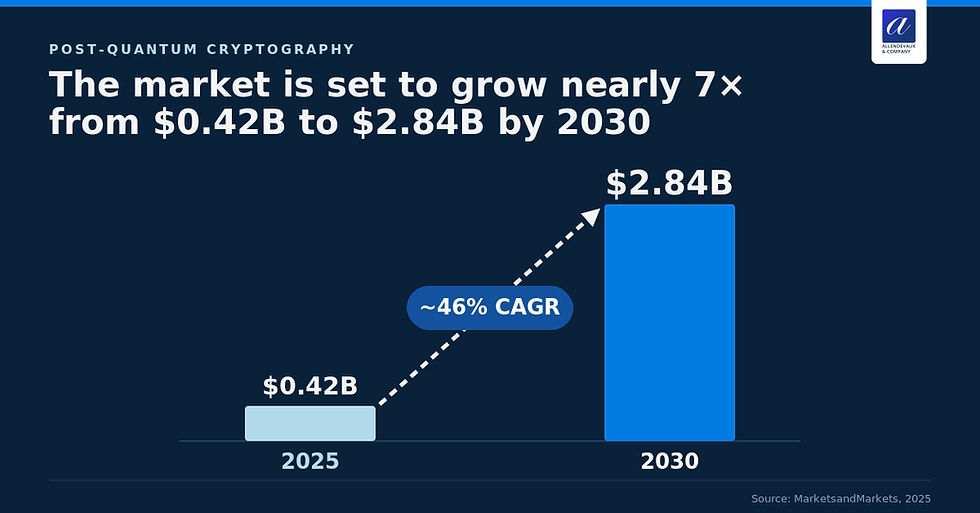
While organizations focus on today’s threats, another transformation is already underway.
The Post-Quantum Cryptography (PQC) market is projected to grow from $0.42 billion in 2025 to $2.84 billion by 2030, representing nearly 46% compound annual growth.
This rapid growth reflects growing awareness around a difficult reality:
Today’s encryption standards may eventually become vulnerable to future quantum computing capabilities.
Although large-scale quantum attacks may still be years away, organizations are beginning to recognize that cryptographic migrations cannot happen overnight.
The transition to quantum-resistant security models requires:
Asset inventories
Cryptographic discovery
Long-term migration planning
New governance frameworks
Organizations that delay preparation may face significant challenges later.
Four Trends, One Common Theme
At first glance, these developments may appear unrelated.
But they all point toward the same conclusion:
The cyber threat landscape is becoming increasingly interconnected and exponentially more complex.
Organizations now face challenges across multiple fronts:
Increasing Attack Volume
Threat actors are scaling faster than ever.
Expanding Attack Surfaces
IoT and digital transformation continue to create new exposure points.
Ecosystem Weaknesses
Smaller organizations remain vulnerable, creating supply chain risks.
Future Cryptographic Disruption
Quantum computing is already reshaping long-term security strategies.
Cybersecurity can no longer be viewed as a collection of individual controls.
It must become a continuous strategy for managing interconnected risk.
The Bigger Shift: Security Is Becoming a Business Resilience Function
The organizations that succeed in this environment will move beyond traditional cybersecurity thinking.
They will focus on:
Continuous visibility
Proactive risk management
Ecosystem-wide resilience
Future-ready security strategies
Adaptive governance models
Because modern cyber threats don’t exist in isolation.
They spread across vendors, devices, cloud platforms, supply chains, and digital ecosystems.
Final Insight: The Attack Surface of the Future Is Already Here
Cybersecurity in 2026 is no longer just about defending networks.
It is about preparing for a world where:
Attacks are more frequent.
Devices are more connected.
Ecosystems are more dependent.
Cryptographic assumptions are changing.
The organizations that thrive will not simply react to individual threats.
They will build resilience for an environment where change itself has become the biggest risk.
Because the future of cybersecurity is not defined by one major threat.
It is defined by the convergence of many smaller ones—and how prepared organizations are to manage them together
FAQs
What Are the Biggest Cybersecurity Trends in 2026?
The biggest cybersecurity trends in 2026 include increasing cyberattack volumes, expanding IoT vulnerabilities, post-quantum cryptography planning, supply chain risks, and a stronger focus on cyber resilience.
Why Is IoT Security Important in 2026?
The rapid growth of connected devices has significantly expanded the attack surface. Many IoT devices contain critical vulnerabilities, making them attractive targets for cybercriminals.
What Is Post-Quantum Cryptography?
Post-Quantum Cryptography (PQC) refers to cryptographic algorithms designed to resist attacks from future quantum computers. Organizations are already planning migrations to protect long-term data security.
Why Is Cyber Resilience More Important Than Ever?
Modern cyber threats affect interconnected ecosystems, including cloud platforms, suppliers, IoT devices, and third-party services. Cyber resilience focuses on preventing, responding to, and recovering from these evolving threats.



Các mối đe dọa mới trong an ninh mạng thường không xuất hiện theo kiểu dễ nhận ra, nên phần nói về việc doanh nghiệp phải chuẩn bị trước làm tôi chú ý. Tôi thấy đáng suy nghĩ nhất là con người và quy trình vẫn có thể trở thành điểm yếu, dù công cụ được cập nhật. Trước đây tôi từng nghe nhắc đến Game bài đổi thưởng trong một cuộc trò chuyện về thói quen giải trí trên mạng, có tên JD88 được nói qua, nhưng tôi không có trải nghiệm riêng để nhận xét. Bài này làm tôi nhìn chuyện bảo mật thực tế hơn, nhất là ở những khoảng trống nhỏ trong sinh hoạt hằng ngày.
Bài viết về xu hướng an ninh mạng nhắc đến các mối đe dọa mới mà doanh nghiệp cần chuẩn bị. Tôi không làm trong lĩnh vực này, nhưng những ví dụ về rò rỉ dữ liệu và lừa đảo trực tuyến đủ để tôi thấy cần cẩn trọng hơn với mật khẩu và liên kết lạ. Đọc xong tôi nhớ một lần trong nhóm bạn nói về giải trí trực tuyến, có nhắc JW88 như một tên tôi từng nghe; tôi chưa tìm hiểu và không có ý kiến. Điều tôi rút ra là bảo mật không chỉ là vấn đề của bộ phận IT, mà bắt đầu từ thói quen của từng người.
The theme of building confidence through manageable learning goals makes me curious about what people notice in their own everyday experiences. A clear first step can make a difficult subject feel more approachable. I would connect Eng For You with practical learning skills through an ordinary example rather than a broad claim. It leaves me curious about the steps between understanding an idea and putting it into practice. How do you decide what to practise when a topic initially seems too broad?
A number-based name such as R777 can be easy to remember while leaving its subject open to interpretation. I would rather look for a clear description than assume the repeated digits explain what the site is about. That is my starting point for R777 website identity. A distinct identity becomes useful when it connects to understandable information and a clear purpose. I like that first moment of clarification, when a memorable label gives way to a question the reader can actually follow.
A name like Planeta Urwisow sounds playful and full of energy. It makes me think about children exploring a small world through movement, questions, and attempts that do not all look the same. That is the theme I associate with Planeta Urwisow children's play. I enjoy the idea of activities that leave room for a child's own curiosity while still giving the group a shared purpose. A simple game can become more interesting when everyone has a way to contribute something.