

AI Governance: Why AI Visibility Must Come Before AI Risk Management
Your employees are adopting AI faster than you can see it. Someone installs a browser extension that summarises web pages. A developer connects a coding assistant to the company repository. A SaaS platform you approved two years ago switches on an AI feature in its latest release. None of it went through a review, and most of it never will.
That is the real starting point for AI governance. Before you can write a sensible policy, assess risk or apply controls, you need to know what AI is actually running in your organisation. Here is why visibility has to come first, and how to build governance that holds up.
AI doesn't arrive through procurement

Traditional technology governance assumes new tools come through the front door: a purchase request, a vendor assessment, a contract. AI mostly skips that door. It arrives through tools, endpoints, integrations and data connections that nobody reviewed. The most common entry points are:
• Web and desktop apps: chat assistants and AI writing tools, often used with personal or free accounts.
• Browser extensions: add-ons that can read page content, including internal systems open in the same browser.
• Developer environments: coding assistants and model APIs wired into repositories and build pipelines.
• Local models: open-weight models downloaded and run directly on laptops and workstations.
• Agents and plugins: tools that act on a user's behalf across email, files and business applications.
• AI-enabled SaaS: new AI features added to platforms you already pay for.
None of these show up on an invoice, and most don't show up on an asset register either. A policy written from the approved-tools list ends up governing only a small part of the AI actually in use.
A raw tool list is not visibility

The natural first move is to run a discovery scan and export the results. That is a start, but a list of tool names is not visibility. Approved and unknown tools sit side by side on the same spreadsheet, and only one of them is governed. Real visibility answers four questions that a list can't:
1. What AI is actually present? That includes AI features inside approved software, not just standalone apps.
2. Where, and by whom, is it used? The same transcription tool carries a different risk in marketing than it does in HR or legal.
3. Which findings genuinely matter? Discovering 200 tools does not mean you have 200 problems.
4. Where should controls be applied? On the user, the device, the browser or the data, depending on the risk.
Until you can answer these, the list is just a longer description of the problem.
Security teams already see AI governance as the priority
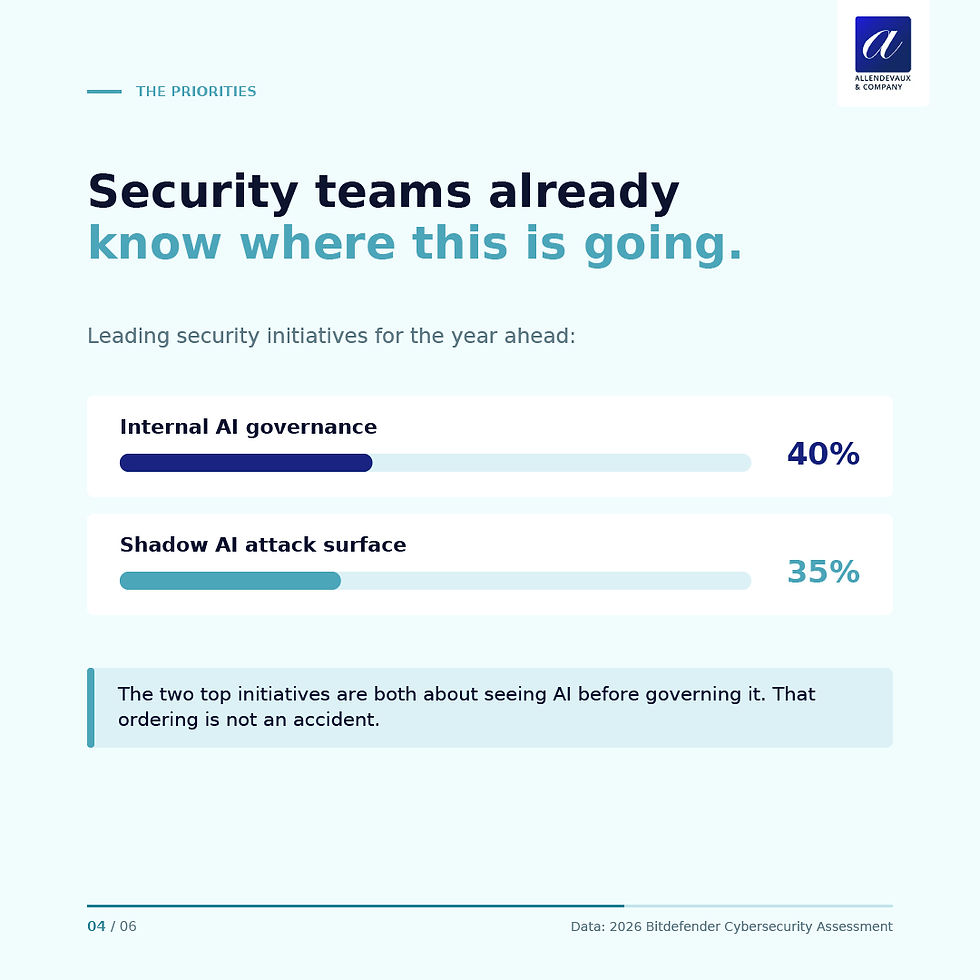
This is not a fringe concern. In Bitdefender's 2026 Cybersecurity Assessment, a survey of 1,200 IT and security professionals across six countries, the two leading security initiatives for the year ahead were:
• Implementing comprehensive internal AI governance: 40%
• Attack surface management for shadow AI: 35%
The same research found that 44.8% of respondents track their official enterprise AI tools but lack visibility into individual shadow AI subscriptions or personal accounts used for work.
The order of those priorities is telling. The top two initiatives are both about seeing AI before governing it. Security teams have learned that governance built on an incomplete picture doesn't hold.
From assume breach to prevention-first security

For the past decade, much of security strategy rested on assuming the breach: accept that attackers will get in, then invest in detecting and responding quickly. That mindset still has value, but AI is forcing a harder question. What has to happen before a breach?
Attackers now use AI to generate, adapt and launch attacks at machine speed. The time between vulnerability discovery, weaponisation and exploitation keeps shrinking. In the same Bitdefender survey, 59% of respondents said their organisation had faced social engineering attacks they believe involved AI.
When the attack cycle compresses like this, relying mainly on detection becomes a race you can't win. Finding attacks faster is good. Having fewer to find is better. Detection stays the backstop, not the whole strategy.
Ungoverned AI adds exactly the kind of exposure attackers look for: data flowing to services nobody vetted, extensions with broad permissions, agents holding tokens to business systems. Removing that exposure is prevention work, and it starts with knowing where it is.
Four steps to AI governance that holds up
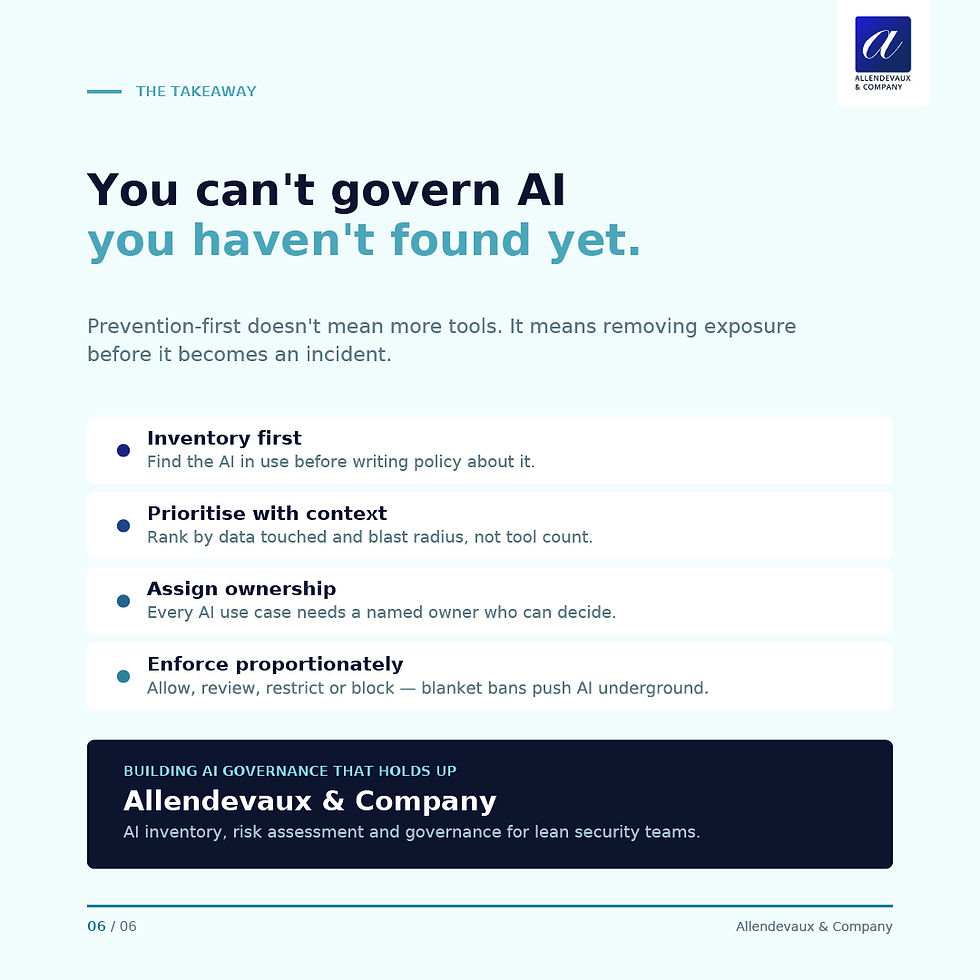
Prevention-first doesn't mean buying more tools. It means removing exposure before it becomes an incident. For most organisations, and especially lean security teams, that comes down to four steps:
1. Inventory first. Find the AI in use before writing policy about it. Cover embedded SaaS features, extensions, developer tooling and local models, and repeat discovery regularly, because the picture changes every time a vendor ships an update.
2. Prioritise with context. Rank findings by the data each tool touches and the blast radius if something goes wrong, not by tool count. An AI note-taker sitting in board meetings matters more than a dozen image generators used for social posts.
3. Assign ownership. Every AI use case needs a named owner with the authority to approve it, set conditions or retire it. Without an owner, findings sit in a queue.
4. Enforce proportionately. Use a graded response: allow, review, restrict or block. Blanket bans rarely stop AI use. They push it onto personal devices and accounts, where you see even less.
These steps also prepare you for frameworks such as ISO/IEC 42001 and the EU AI Act, both of which assume you know which AI systems you use and who is accountable for them.
Not sure what AI is running in your organisation? Allendevaux & Company helps lean security teams with AI inventory, risk assessment and governance. Contact our team to find out where your AI exposure sits and what to fix first.
Frequently asked questions
What is AI governance?
AI governance is the set of policies, roles, processes and controls an organisation uses to manage how AI is adopted and used. It covers which tools are allowed, what data they can access, who owns each use case and how usage is monitored.
What is shadow AI?
Shadow AI is any AI tool, feature or integration used without the knowledge or approval of IT and security. It includes personal chatbot accounts, browser extensions, local models and AI features switched on inside approved SaaS platforms.
Why should an AI inventory come before an AI policy?
A policy can only govern what you know about. Without an inventory, it covers the approved tools and misses the extensions, embedded features and developer tooling where most unreviewed AI use happens.
Should we ban unapproved AI tools?
Blanket bans tend to push AI use onto personal devices and accounts, which reduces visibility. A graded approach of allow, review, restrict or block controls the risky uses while keeping the productive ones in view.
How do we prioritise AI risks?
Rank each finding by the sensitivity of the data it touches and the potential blast radius, then assign an owner. A tool with access to customer records or source code deserves attention before one used for low-risk tasks.


Comments