

Privacy Governance in 2026: From Compliance to Digital Trust
Privacy didn't just change over the last decade. It changed what organizations are expected to govern. In 2016, a privacy program was mostly a legal exercise. In 2026, it is operational infrastructure that touches data, vendors, AI systems and security every day.
Here is how privacy governance evolved, and what it means for the next ten years.
Then vs now: from documentation to operations
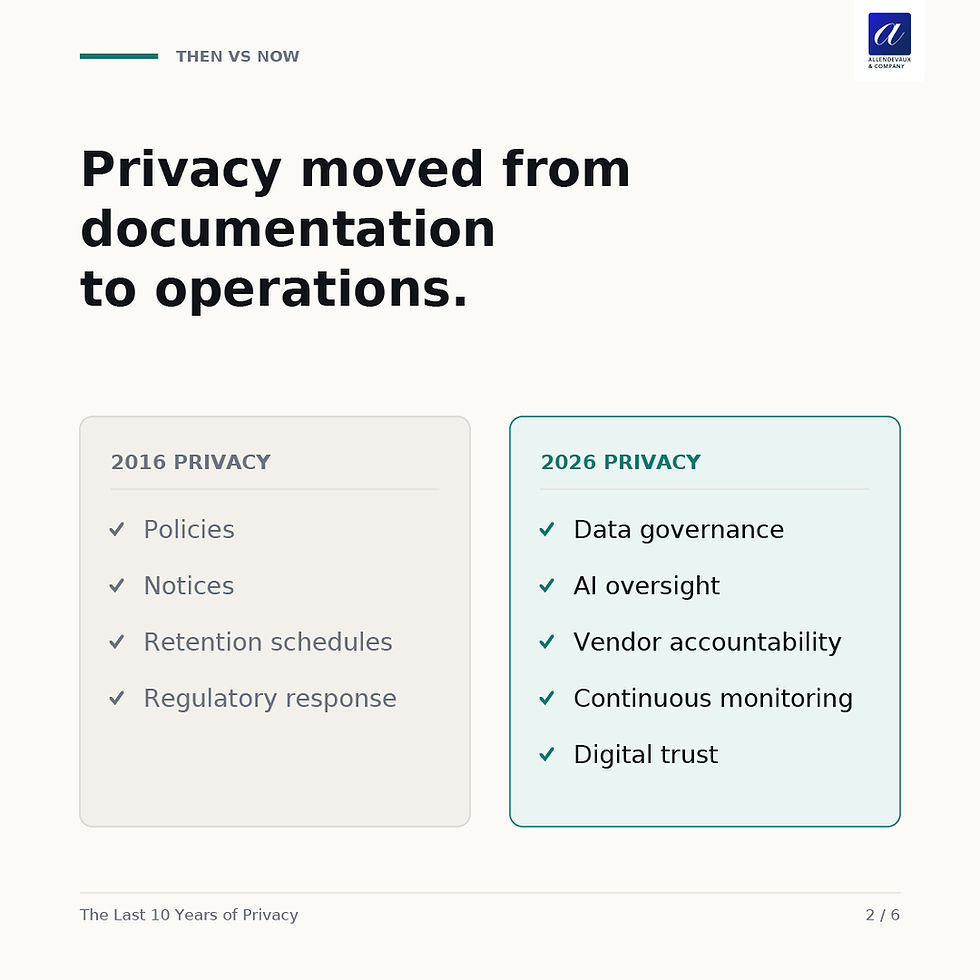
Ten years ago, a solid privacy program meant good paperwork: policies, privacy notices, retention schedules and a plan for responding to regulators. Those still matter, but they are now the starting point.
Today's programs are expected to cover data governance, AI oversight, vendor accountability, continuous monitoring and digital trust. The work has moved out of the policy binder and into daily operations. A notice describes intent; a data inventory, a vendor register and live monitoring show what actually happens.
GDPR changed the question to “prove it”

When GDPR became enforceable in 2018, saying you were compliant stopped being enough. Organizations suddenly needed:
• Records of processing activities
• Consent governance
• Workflows to fulfill data subject rights requests
• Oversight of vendors and processors
• Accountability mechanisms that stand up to scrutiny
For the first time, privacy became measurable. Regulators could ask for evidence, and organizations had to produce it.
Compliance became operational

Regulators now look past the policy to the practice. The questions they increasingly ask are practical:
• Do opt-outs actually work?
• Can you locate personal data everywhere it lives?
• Are AI-driven decisions explainable?
• Can you demonstrate governance in practice, not just on paper?
Answering them takes a chain that runs from policy to system to enforcement to evidence. Policies alone are no longer sufficient. Operational enforcement is now the standard.
AI accelerated the governance challenge
AI added a new set of questions: what data is being used, who owns the system, how decisions are made, what risks exist and whether outcomes can be explained. Laws such as the EU AI Act and standards such as ISO/IEC 42001 now put formal structure around them.
The bigger shift is that privacy, AI, security, data governance and resilience no longer operate separately. They are converging into one governance ecosystem, and teams that still run them in silos duplicate effort and leave gaps.
The next decade: governance as a competitive advantage

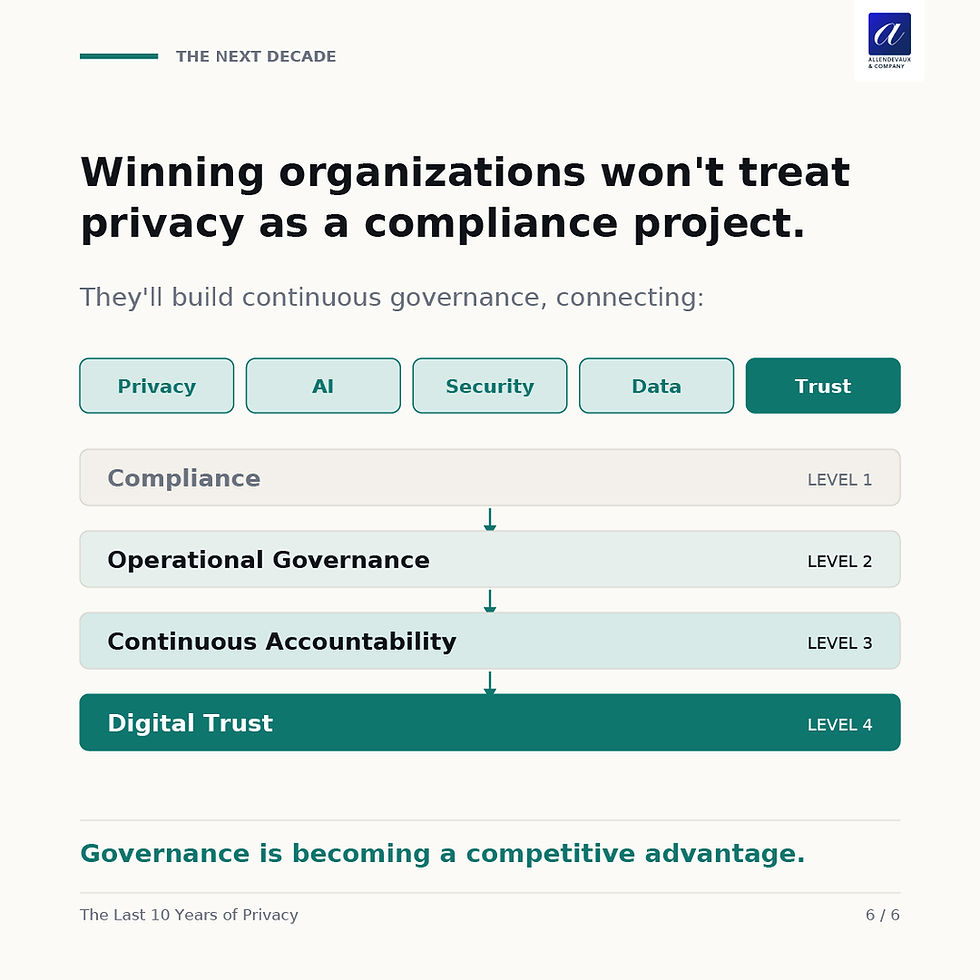
The organizations that win won't treat privacy as a compliance project. They will build continuous governance that connects privacy, AI, security, data and trust. Most programs sit somewhere on this maturity path:
1. Compliance: meeting the minimum legal requirements.
2. Operational governance: controls built into systems and processes.
3. Continuous accountability: ongoing monitoring with evidence on demand.
4. Digital trust: governance that customers, partners and regulators can rely on.
Each level builds on the last. The further along you are, the easier it is to pass audits, win customer confidence and adopt AI safely.
Where does your program sit today? Allendevaux & Company helps organizations move from compliance to continuous, operational governance across privacy, AI and security. Contact our team to assess your privacy governance maturity.
Frequently asked questions
What is privacy governance?
It is the set of policies, roles, controls and evidence an organization uses to manage personal data responsibly. Today it covers data, vendors, AI systems and continuous monitoring, not just policies and notices.
How did GDPR change privacy compliance?
GDPR made accountability the standard. Organizations had to keep records of processing, govern consent, handle rights requests, oversee vendors and prove compliance with evidence.
What is the difference between privacy compliance and operational governance?
Compliance documents what should happen. Operational governance builds it into systems, enforces it and produces evidence that it works.
How does AI governance relate to privacy?
AI systems use personal data and make decisions that affect people, so privacy, security and AI governance now overlap. Managing them together avoids gaps and duplicated effort.
How can we measure privacy program maturity?
A simple model has four levels: compliance, operational governance, continuous accountability and digital trust. Moving up means stronger enforcement and better evidence.


Comments