

Why One AI Pentest Run Isn’t Enough: The Case for Continuous Testing
AI can find vulnerabilities. The harder question is whether you can trust what it missed. Autonomous pentest agents are genuinely useful: they adapt, they explore and they scale. But a single run is a sample of what the tool happened to try that day, not a measure of your exposure. Here is why autonomous penetration testing needs more than one run, and what a reliable setup looks like.
The non-determinism problem

AI pentest agents do not necessarily follow the same testing paths twice. The same target, scope and instructions can produce different results, because the agent's choices vary from run to run. That shows up as vulnerabilities missed in one run and found in another, testing steps skipped or applied inconsistently, different attack paths explored each time, and no dependable picture of coverage. The issue is not only what the AI finds. It is what it leaves behind.
One run can miss what another finds
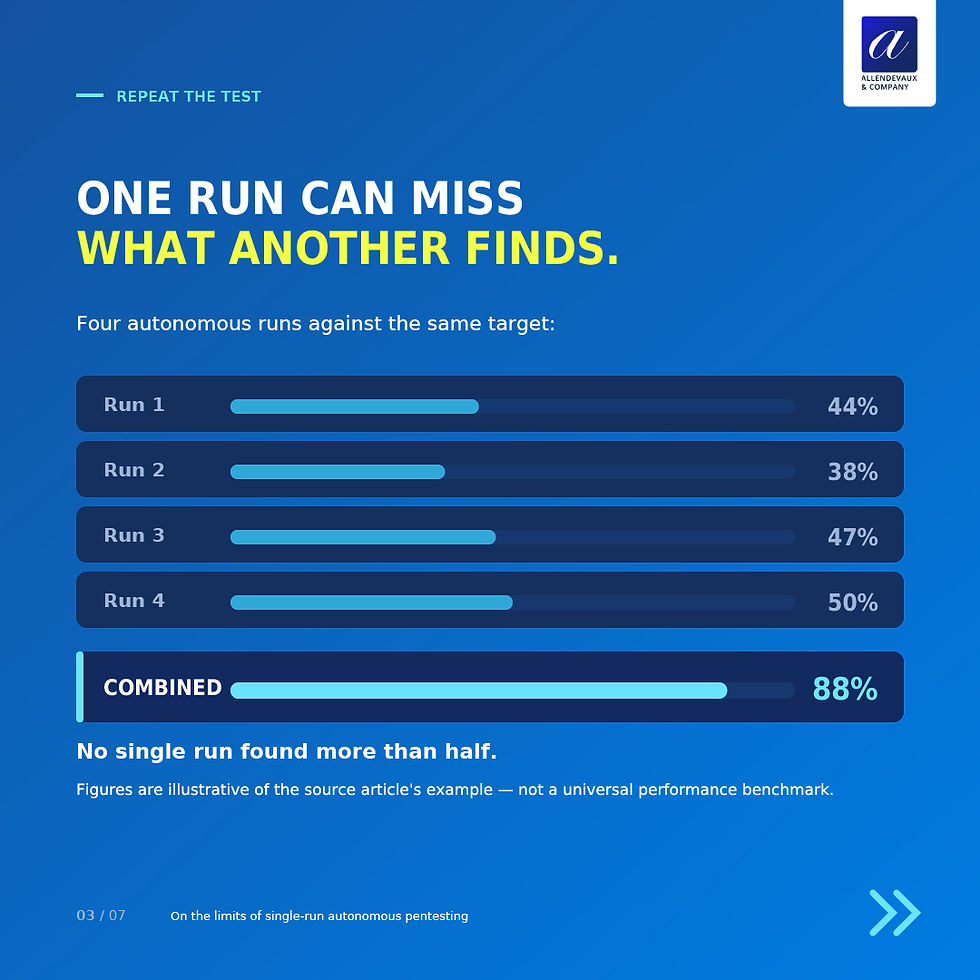
The pattern is easy to illustrate. Across four autonomous runs against the same target, the individual runs found 44%, 38%, 47% and 50% of the vulnerabilities, while all four combined reached 88%. No single run found more than half. Those figures illustrate one worked example rather than a universal benchmark, but the shape of the result is the point: repeating the test changes the answer.
More runs raise confidence, not proof

Four runs still were not the whole picture, which leads to the question nobody can answer: how do you know when you have found everything? You do not know how many vulnerabilities exist in the target, so you cannot calculate how many reruns would be enough. Additional runs raise confidence. They do not prove completeness, and a report that implies otherwise is overselling the method.
Autonomous doesn't mean self-sufficient

Scanners and AI agents are good at different things. Scanners excel at known vulnerabilities via signatures, established security flaw checks and repeatable checks at scale. AI pentesters add investigation of potential attack paths, iterative exploration of behavior, examination of how weaknesses interact, and adaptation to what they discover. AI pentesting should complement the tooling and the people you already have, not replace them.
Reliability comes from layers

Better AI pentesting is a system, not a run:
1. Multiple runs to widen discovery across testing paths.
2. Multiple models to introduce diversity of approach.
3. Proven tools: established scanners and methodologies alongside the agents.
4. Human oversight to review test plans and validate findings.
5. Auditable execution that records methodology and activity.
No single technique solves non-determinism. Reliability comes from the combination.
Don't just automate the test. Validate the coverage. Repeated AI testing, vulnerability scanners and human validation together produce what a single run cannot: assurance that rests on evidence rather than on the fact that a test ran. The goal is not more AI runs. It is more trustworthy results.
Evaluating AI-assisted pentesting? Allendevaux & Company combines repeated testing, established tooling and human validation, and reports coverage as well as findings. Contact our team, or email info@allendevaux.com.
Frequently asked questions
What is autonomous penetration testing?
AI agents that plan and carry out testing against a target with limited human direction, exploring attack paths rather than only matching known signatures.
Why do AI pentest results differ between runs?
The agents do not follow fixed paths. Their choices vary, so the vulnerabilities surfaced and the coverage achieved vary with them.
Is a single AI pentest run enough for compliance?
No. A completed run is not evidence of coverage, and auditors ask for methodology, validation and records, not a tool's raw output.
Does AI replace vulnerability scanners or human testers?
No. Scanners provide repeatable breadth, AI adds adaptive exploration, and people validate exploitability and sign off on what the results mean.
How many runs are enough?
There is no way to calculate it, because the total number of vulnerabilities is unknown. Combine repeated runs with scanners and human review instead of chasing a number.
The four-run figures illustrate one published example of single-run variability, not a universal performance benchmark for AI pentest tools.



Comments