

What Is ISO/IEC 27018? The Cloud Privacy Standard Explained
Your Cloud Is Secure. But Is Personal Data Truly Protected?
Cloud security has become a major business priority.
Organizations invest heavily in:
Firewalls
Encryption
Identity management
Threat detection
Security certifications
Yet one important question is increasingly being asked by customers, regulators, and business leaders:
“How is my personal data actually being protected in the cloud?”
Because securing infrastructure and protecting personal information are no longer the same thing.
This is where ISO/IEC 27018 becomes critical.
Cloud Adoption Has Changed the Privacy Landscape
Modern businesses rely heavily on cloud services.
Customer information, employee records, financial data, and business applications are now distributed across multiple cloud platforms.
This transformation has created tremendous flexibility—but it has also introduced new privacy challenges.
As highlighted in the deck, personal data has become more distributed than ever before, making governance significantly more complex.
Organizations must now answer difficult questions:
Who can access personal data?
How is it being processed?
Where is it stored?
What happens when customers request deletion?
Security alone can no longer answer these questions.
What Is ISO/IEC 27018?

ISO/IEC 27018 is the international standard specifically designed for protecting Personally Identifiable Information (PII) in public cloud environments.
As outlined in the framework, it provides guidance for:
Protecting personal data in the cloud
Defining responsibilities between cloud providers and customers
Ensuring transparency and accountability in data handling
Think of it as:
ISO 27001 + Privacy Controls for Cloud Data.
While ISO 27001 focuses on information security management, ISO 27018 extends those principles by introducing structured privacy protections specifically for cloud environments.
Why ISO 27018 Matters More Than Ever

The need for privacy-focused cloud governance continues to grow.
According to the deck, several major trends are driving this shift:
Privacy Regulations Are Increasing
Organizations must now comply with growing global privacy requirements, including:
GDPR
CCPA
Emerging privacy laws across multiple jurisdictions
Customers Demand Greater Transparency

Trust is increasingly becoming a competitive differentiator.
Customers no longer simply ask whether organizations are secure.
They want to know:
How their personal data is being handled.
Data Breaches Increasingly Involve PII
Personally identifiable information remains one of the most valuable targets for attackers.
When PII is exposed, organizations face:
Financial losses
Regulatory investigations
Reputation damage
Loss of customer trust
This is why structured privacy controls have become essential.
Privacy Must Become an Operational Control
One of the strongest messages from the framework appears on page four:
Privacy becomes an operational control—not just a policy.
ISO 27018 introduces core privacy principles such as:
Consent and purpose limitation
Transparency in data processing
Data deletion and return mechanisms
Restrictions on unauthorized processing
Accountability and auditability
Strong protection of customer PII
This represents a major shift.
Privacy is no longer simply a legal document or compliance statement.
It becomes embedded into everyday cloud operations.
Who Should Care About ISO 27018?
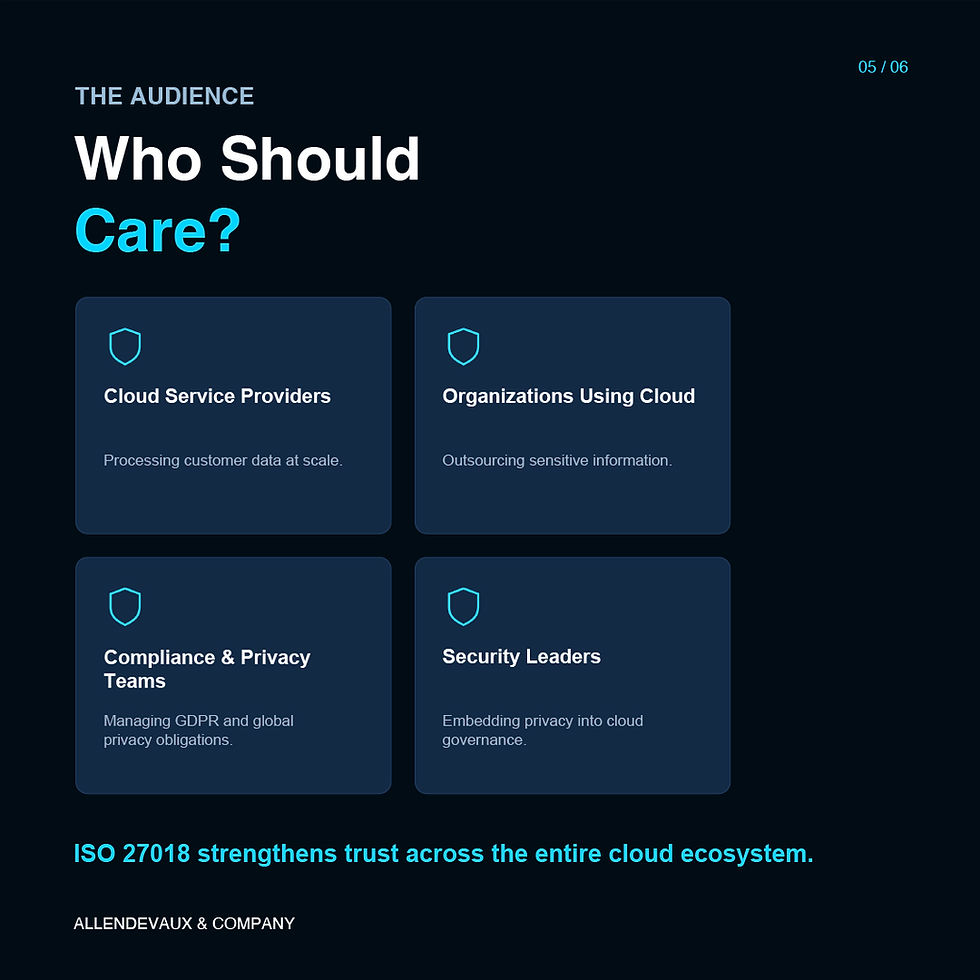
The standard is relevant across the entire cloud ecosystem.
According to the deck, ISO 27018 is particularly important for:
Cloud Service Providers
Organizations processing large volumes of customer data.
Organizations Using Cloud Services
Businesses outsourcing sensitive information to third-party environments.
Compliance and Privacy Teams
Teams responsible for meeting GDPR and global privacy obligations.
Security Leaders
Professionals seeking to integrate privacy into cloud governance strategies.
In reality, almost every modern organization now falls into one or more of these categories.
The Bigger Shift: Security Alone Is No Longer Enough
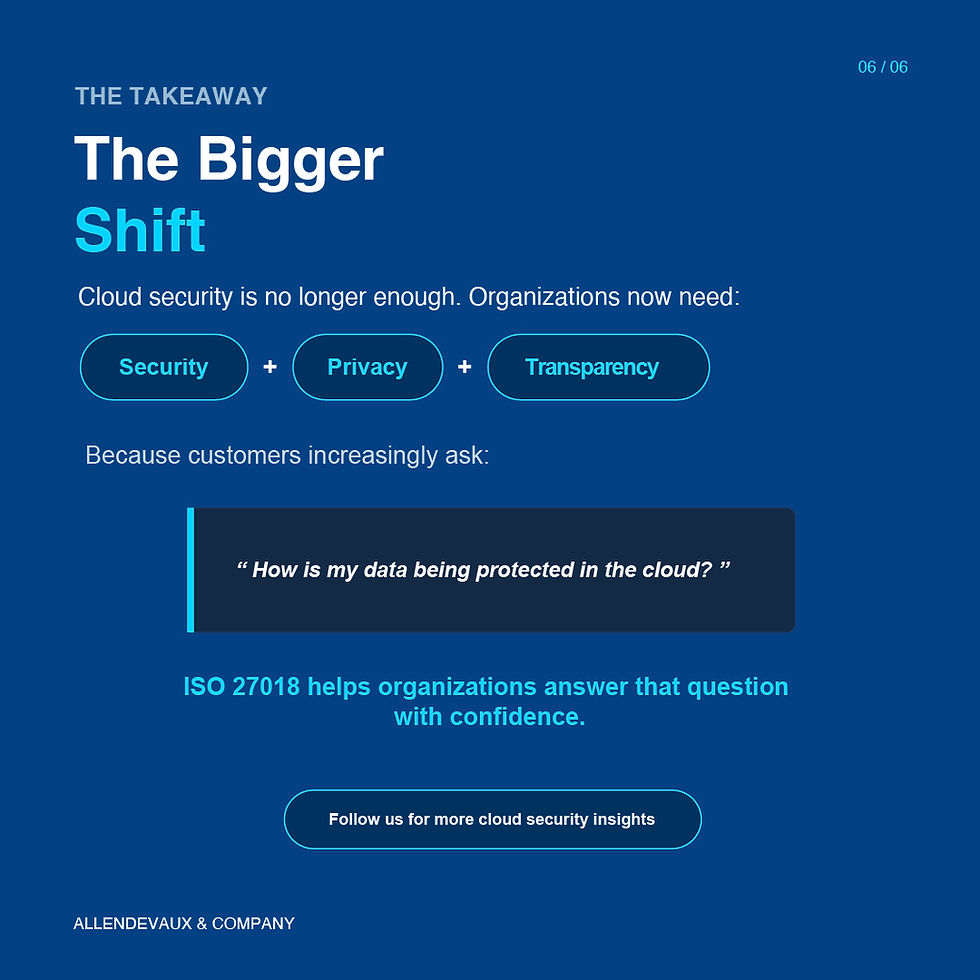
Perhaps the most important message from the final slide is this:
Cloud governance now requires:
This reflects a major evolution in customer expectations.
Organizations are increasingly judged not only on their ability to secure systems, but also on their ability to explain:
How data is processed
Who has access to it
How long it is retained
What controls exist to protect it
Trust is becoming inseparable from transparency.
Why ISO 27018 Builds Competitive Advantage
Privacy is no longer just a compliance issue.
It has become a business differentiator.
Organizations that can confidently demonstrate responsible handling of personal data are more likely to:
Build customer trust
Strengthen business partnerships
Reduce regulatory exposure
Improve cloud governance maturity
Differentiate themselves in competitive markets
In many industries, trust is becoming as important as security itself.
Final Insight: The Future of Cloud Security Is Privacy-Centric
The cloud has fundamentally changed how organizations handle information.
But as personal data becomes increasingly distributed, traditional security controls alone are no longer enough.
Organizations need frameworks that combine:
Security
Privacy
Accountability
Transparency
ISO/IEC 27018 provides exactly that.
Because the most important question customers increasingly ask is no longer:
“Is your cloud secure?”
It’s:
“Can I trust you with my data?”
And ISO 27018 helps organizations answer that question with confidence.

Comments