

Lost Pet Scams Are Rising: How AI Is Exploiting Missing Pet Owners
Your Pet Is Missing. Scammers Already Know.
Losing a pet is one of the most stressful experiences a family can go through.
Within minutes of posting online, emotions take over:
Hope
Fear
Desperation
The need to act quickly
Unfortunately, cybercriminals understand this better than anyone.
And now, artificial intelligence is making it easier for them to exploit pet owners during some of their most vulnerable moments.
The New Scam: Criminals Are Watching Lost Pet Posts

The internet has made it easier than ever to spread information about missing pets.
Owners post in:
Facebook groups
Community forums
Lost pet networks
Neighborhood apps
But these platforms aren’t just being monitored by helpful community members.
Scammers are watching too.
As highlighted in the deck, fraudsters often contact pet owners within minutes, claiming they’ve found the missing animal.
And that’s where the scam begins.
AI Is Making the Scam More Convincing

Traditional pet scams relied on simple messages.
Today’s scams are different.
As shown on page 3, criminals are increasingly using AI to create:
AI-generated rescue photos
Fake veterinary images
Injured pet “proof” pictures
Fabricated treatment scenarios
The goal is simple:
Create urgency before you have time to verify the story.
A picture of your pet looking injured or sitting inside a veterinary clinic can trigger an immediate emotional reaction.
And that’s exactly what scammers are counting on.
How the Scam Usually Works
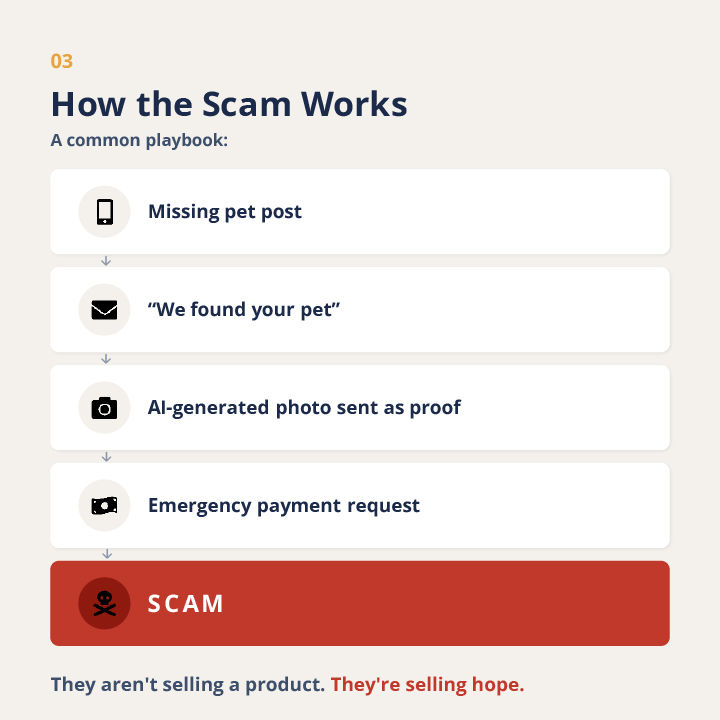
The playbook is surprisingly consistent.
As outlined in the deck, the attack typically follows this sequence:
The criminal may claim:
The pet needs emergency treatment
Transportation costs need to be covered
The finder paid veterinary expenses
Immediate payment is required to release the animal
The message is designed to prevent one thing:
Verification.
They’re Not Selling a Product. They’re Selling Hope.
One of the most powerful insights from the deck appears on page 4:
They aren’t selling a product. They’re selling hope.
Pet owners aren’t making financial decisions in these moments.
They’re making emotional ones.
Scammers understand that:
People act quickly when loved ones are involved.
Emotions often override caution.
Urgency reduces critical thinking.
AI simply makes the deception more believable.
How to Verify Before Sending Money

The good news is that legitimate finders generally cooperate with verification requests.
The deck recommends several simple steps before sending any money:
Request a Live Video Call
Ask to see the pet in real time.
Ask Them to Call the Pet’s Name
A real finder should be able to interact with the animal.
Verify Veterinary Clinics Independently
Never rely solely on the information provided by the caller.
Request Real-Time Proof Only You Would Know
Ask questions that only someone who genuinely has your pet could answer.
The difference is often simple:
Legitimate finders cooperate. Scammers avoid verification.
Why AI Makes Emotional Scams More Dangerous
The final lesson of the deck extends far beyond missing pets.
AI isn’t just creating fake content.
It’s making emotional manipulation more convincing.
The technology allows criminals to:
Create realistic images in seconds
Fabricate believable stories
Exploit trust more effectively
Pressure victims before facts can be checked
This is a broader cybersecurity issue.
The future of fraud will increasingly rely on manipulating emotions rather than bypassing technology.
Final Insight: Pause. Verify. Then Trust.
When a pet goes missing, every message feels important.
But urgency is exactly what scammers depend on.
The strongest defense remains remarkably simple:
Pause. Verify. Then Trust.
Because in the age of AI, the most convincing story isn’t always the true one.
And sometimes, the person claiming they’ve found your pet is really trying to find something else:
Your money and your trust.
FAQs
Q: What Is a Lost Pet Scam?
A lost pet scam occurs when criminals falsely claim they have found your missing pet and demand money before providing proof.
Q: How Do Scammers Find Missing Pet Owners?
Scammers monitor social media posts, neighborhood groups, and lost pet websites for new missing pet reports.
Q: How Can I Verify Someone Really Found My Pet?
Request a live video call, ask them to call your pet by name, and independently verify any veterinary clinic information.
Q: Are AI-Generated Pet Photos Being Used in Scams?
Yes. Criminals increasingly use AI-generated images and fake veterinary photos to make their stories appear legitimate.



Comments