

What Is Malvertising? How Fake Ads and AI Investment Scams Work
The Ad Looked Legitimate. The Scam Was Already in Motion.
Scrolling through social media has become second nature.
A sponsored investment opportunity.A celebrity-endorsed product.A limited-time financial offer.
At first glance, everything looks legitimate.
The branding feels familiar. The platform appears trustworthy. The ad even carries the credibility of a paid promotion.
But as highlighted in the opening slide of the deck, by the time many users recognize something is wrong, the scam is already in motion.
This is the reality of modern malvertising—a growing cybercrime ecosystem that uses legitimate advertising channels to deliver fraud at scale.
Malvertising Is No Longer an Isolated Problem
Many people still think of online scams as isolated incidents carried out by individual fraudsters.
The reality is far more organized.
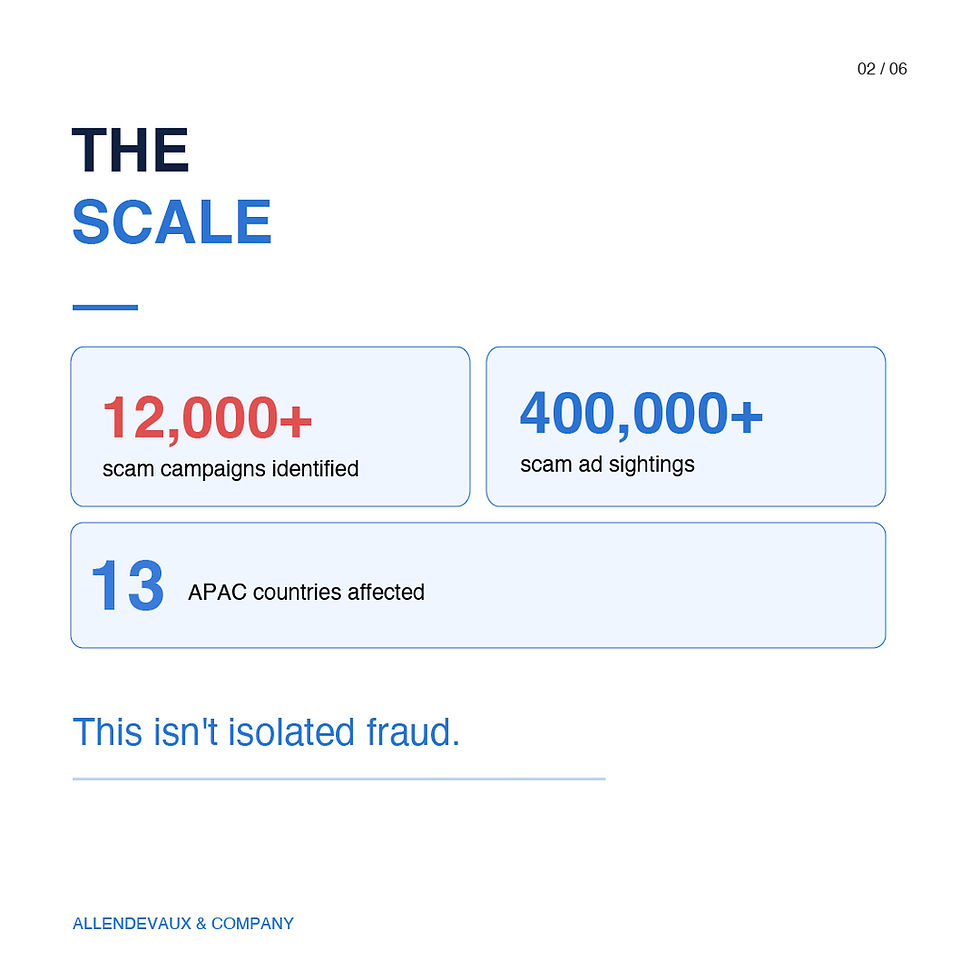
According to the data presented in the deck, researchers identified:
More than 12,000 scam campaigns
Over 400,000 scam ad sightings
Activity spanning 13 countries across the Asia-Pacific region
These numbers reveal something important:
Malvertising is not random fraud.
It is a coordinated ecosystem designed to operate at scale.
Different Ads. The Same Playbook.

One of the most interesting findings highlighted in the deck is that scam advertisements often appear completely different on the surface.
They may promote:
Health products
Investment opportunities
Financial services
Celebrity stories and endorsements
Yet behind the scenes, they follow the same formula:
Ad → Redirect → Scam
The story changes.
The infrastructure does not.
This consistency allows attackers to rapidly adapt campaigns while continuing to use proven fraud techniques.
The Most Common Malvertising Tactics

The deck identifies three tactics that repeatedly appear across campaigns.
Fake App Downloads
Attackers impersonate trusted brands, applications, and platforms.
Users believe they are downloading a legitimate app or software update when they are actually installing malicious software or handing over sensitive information.
Scandal and Celebrity Bait
Fraudsters create sensational stories involving celebrities, public figures, or controversial events.
These campaigns are designed to exploit curiosity and encourage clicks before users have time to verify the source.
AI Investment Scams
One of the fastest-growing themes involves promises of automated wealth generation.
Ads promote:
AI-powered trading systems
Guaranteed investment returns
Automated profit platforms
The message is often simple:
“Let AI make money for you.”
The outcome is usually the same—financial fraud.
Why These Scams Work So Well
The success of malvertising has little to do with technical sophistication.
It has everything to do with psychology.
As outlined in the deck, successful campaigns exploit:
Trust in familiar brands
Urgency and curiosity
The credibility of sponsored advertisements
Redirect chains hidden behind legitimate-looking links
By the time a user realizes they have left the original platform, the attack has already progressed.
In many cases, victims never notice the transition at all.
The Hidden Danger of Redirect Chains
One of the most overlooked aspects of malvertising is what happens after the click.
Users rarely land directly on a scam page.
Instead, they are often routed through multiple redirects designed to:
Evade detection
Track user behavior
Customize scam content
Filter targets based on geography or device type
This layered approach makes malicious campaigns harder to identify and more difficult for platforms to disrupt.
Why Traditional Awareness Isn’t Enough
Many users believe they can spot scams simply by looking for obvious warning signs.
But modern malvertising challenges that assumption.
Today’s campaigns:
Use professional branding
Mimic trusted organizations
Leverage legitimate advertising networks
Continuously adapt their messaging
The result is a threat environment where familiarity itself becomes the weapon.
The Bigger Problem: An Entire Scam Ecosystem
The final message from the deck is perhaps the most important:
Malvertising is not just a content problem. It’s an ecosystem.
An ecosystem built on:
Trust
Scale
Automation
Adaptation
Attackers are no longer relying on suspicious emails alone. They are using advertising systems, social platforms, and consumer trust to distribute scams more efficiently than ever before.
Final Insight: The Most Dangerous Scams Don’t Look Suspicious
The biggest misconception about online fraud is that scams are easy to recognize.
Modern malvertising proves otherwise.
As the closing slide reminds us:
The most successful scams don’t look suspicious. They look familiar.
That is what makes them effective.
And that is why awareness, verification, and healthy skepticism remain some of the most powerful defenses against today’s digital fraud ecosystem.
FAQs
Q: What Is Malvertising?
Malvertising is the use of online advertisements to distribute scams, malware, or fraudulent content through legitimate advertising platforms.
Q: How Do Fake Investment Ads Work?
Fraudsters create ads promising guaranteed returns, AI-powered trading systems, or celebrity-backed investments to trick users into sending money.
Q: How Can I Tell If an Online Ad Is a Scam?
Warning signs include:
Guaranteed profits
Pressure to act quickly
Celebrity endorsements without verification
Requests for deposits or personal information
Redirects to unfamiliar websites
Q: Are Social Media Ads Safe?
Most are legitimate, but scammers increasingly abuse advertising platforms to distribute fraudulent investment schemes, fake apps, and phishing pages.


Comments