

AI vs Human Penetration Testing: Which Is Better for Cybersecurity?
AI pentesting vs. human pentesting is becoming an increasingly important debate as organizations look for faster, broader, and more effective ways to identify cybersecurity vulnerabilities.
AI-powered security testing can continuously discover assets, identify known vulnerabilities, and scale across large environments. Human penetration testers, meanwhile, bring business context, creativity, and the ability to understand complex attack paths.
So, which approach is better?
The answer isn’t AI or humans.
The strongest cybersecurity programs combine both.
AI Pentesting vs. Human Pentesting: What Is the Difference?

AI and human penetration testing solve different problems.
As outlined on page 2 of the presentation, AI finds at scale, while humans find in context.
AI Pentesting
AI-powered penetration testing is particularly effective for:
Continuous asset discovery
Identifying known CVEs and exposed services
Detecting cloud misconfigurations
Finding exposed APIs
Repetitive security checks
Continuous attack surface monitoring
AI can perform these activities repeatedly and at scale, making it useful for organizations with constantly changing digital environments.
Human Pentesting
Human-led penetration testing brings a different level of depth. Experienced testers can identify:
Business logic flaws
Broken authorization
Workflow abuse
Privilege escalation
Multi-step attacks
Vulnerability chains
These vulnerabilities often require understanding how systems, users, and business processes interact.
Finding a Vulnerability Isn’t the Same as Proving an Attack
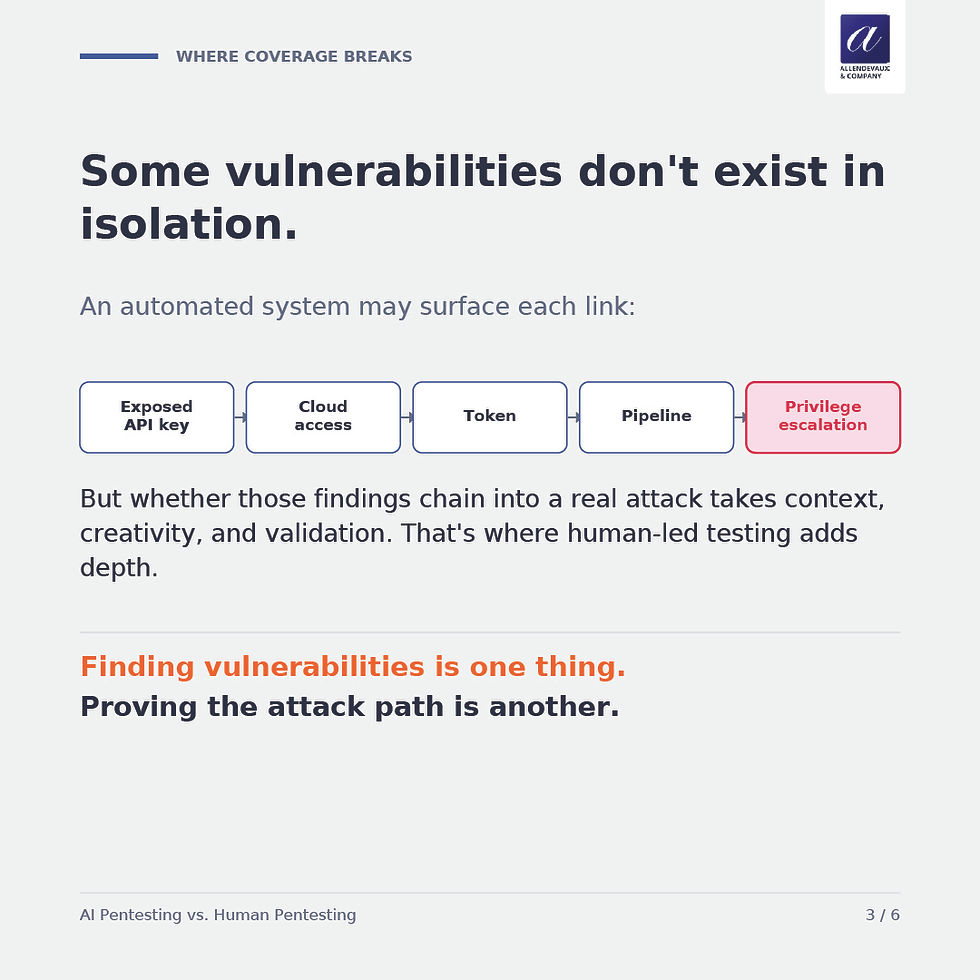
One of the biggest limitations of automated security testing is understanding how individual findings can be combined into a meaningful attack.
The diagramillustrates a potential chain involving an exposed API key, cloud access, a token, a pipeline, and ultimately privilege escalation. An automated system may identify each individual weakness, but determining whether they can realistically be chained into a successful attack requires context, creativity, and validation.
This distinction is critical.
Finding vulnerabilities is one thing. Proving the attack path is another.
Human penetration testers can investigate these relationships and determine the real-world impact of seemingly disconnected weaknesses.
Traditional Pentesting Is Point-in-Time
Traditional penetration testing remains valuable because it provides a deep assessment of an organization’s environment.
However, it is generally performed within a defined testing window:
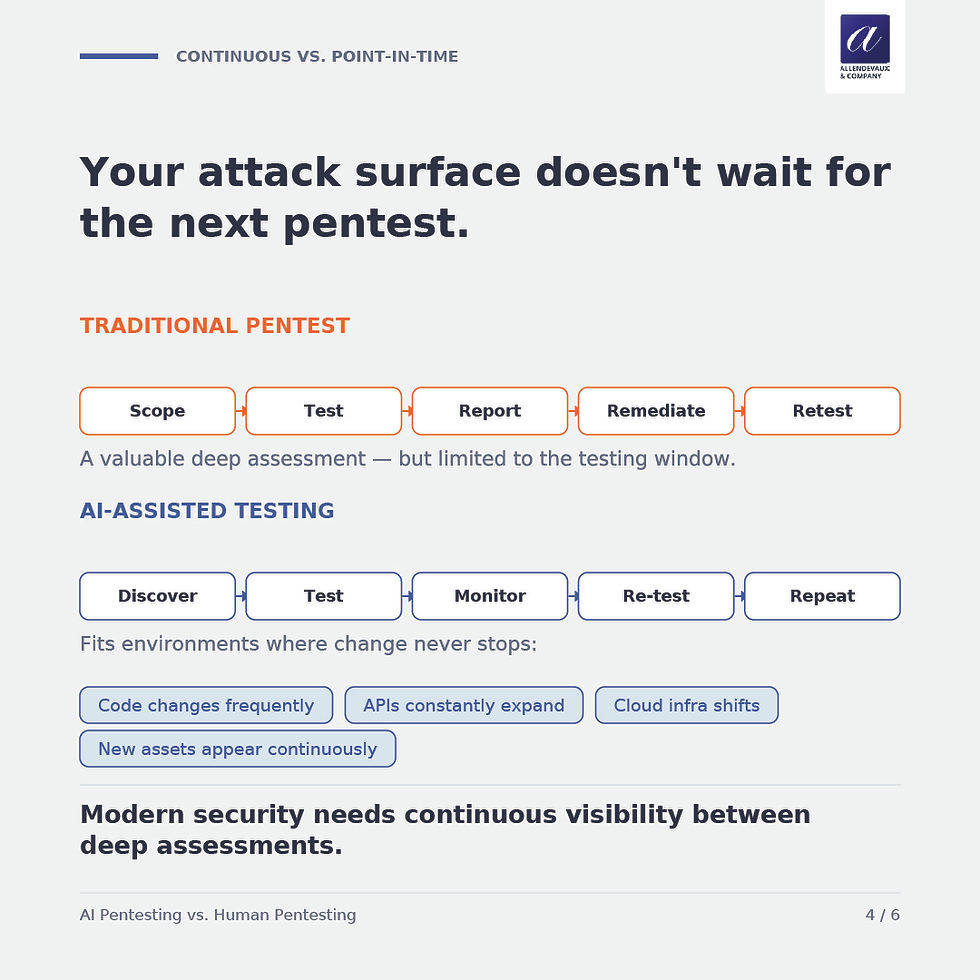
Scope → Test → Report → Remediate → Retest
The problem is that modern attack surfaces don’t wait for the next pentest.
Code changes frequently. APIs expand. Cloud infrastructure shifts. New assets appear continuously.
AI-assisted testing introduces a more continuous model:
Discover → Test → Monitor → Re-test → Repeat
This provides security teams with greater visibility between deep human-led assessments.
The Best Approach Is Hybrid
Rather than replacing human penetration testers, AI can extend their capabilities.
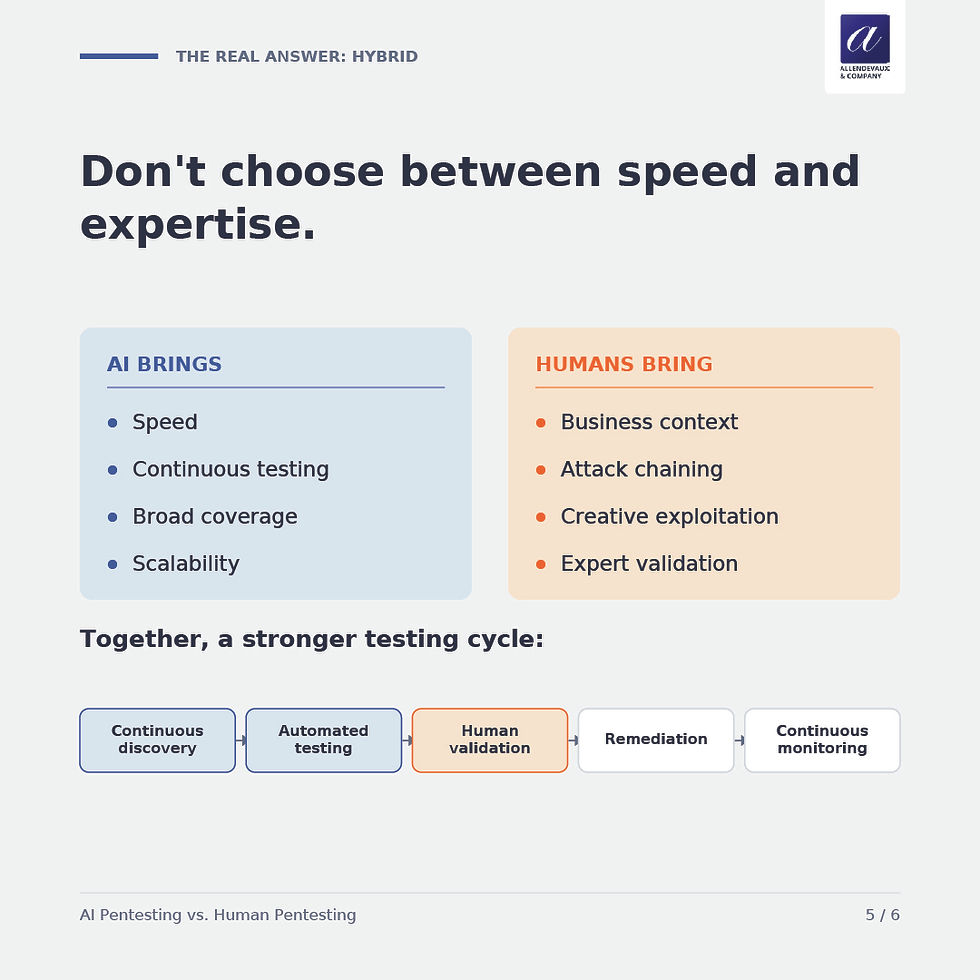
According to page 5 of the presentation, AI contributes:
Speed
Continuous testing
Broad coverage
Scalability
Humans contribute:
Business context
Attack chaining
Creative exploitation
Expert validation
Together, these capabilities create a stronger security testing lifecycle:
Continuous discovery → Automated testing → Human validation → Remediation → Continuous monitoring
This approach combines the scale of automation with the judgment of experienced security professionals.
Why Organizations Need Both
Modern enterprises operate in environments where assets and vulnerabilities change continuously.
AI can help security teams maintain visibility across these changes, while human testers can investigate the vulnerabilities that require deeper reasoning and contextual understanding.

This creates a more balanced cybersecurity strategy:
AI for breadth. Humans for depth. Continuous testing for visibility.
Final Insight: Don’t Choose Between AI and Humans
The future of penetration testing isn’t about replacing human expertise with artificial intelligence.
It’s about using each where it delivers the most value.
AI can dramatically improve the speed, scale, and frequency of security testing. Human penetration testers can validate complex attack paths, uncover business logic weaknesses, and understand vulnerabilities within their operational context.
The strongest programs combine both.
Because modern pentesting isn’t about choosing one approach.
It’s about closing the gaps between them.



Comments