

Executive Identity Exposure: How Stolen SSNs Fuel Cybercrime
Most breach response plans assume the damage ends when the incident is closed. Executive identity data does not work that way. A stolen Social Security number keeps its value for years, and the people whose details circulate most often are the ones with the authority to approve payments, release files and make decisions. Here is why executive identity exposure belongs in your ongoing risk register rather than in a post-incident report.
The data isn't just leaked. It's traded.

Exposed records do not sit idle. They are packaged, priced and resold. One sample of this trade shows the shape of it: 476 compromised SSN records tied to 395 unique individuals, with 73% of the activity aimed at senior leadership. Persistence is what makes it work. A password resets, a card cancels, an SSN does neither. These records are not one-off dumps either; they are inventory, refreshed and cross-referenced as new breaches land.
One identity unlocks multiple attack paths
Executive personal data combines with

public information such as role, employer, travel and relationships to enable executive impersonation, business email compromise, targeted phishing, social engineering, identity fraud and corporate espionage. The more complete the profile, the more convincing the approach, and the less a recipient has to work with when judging whether a request is genuine.
Seniority is the selection criterion
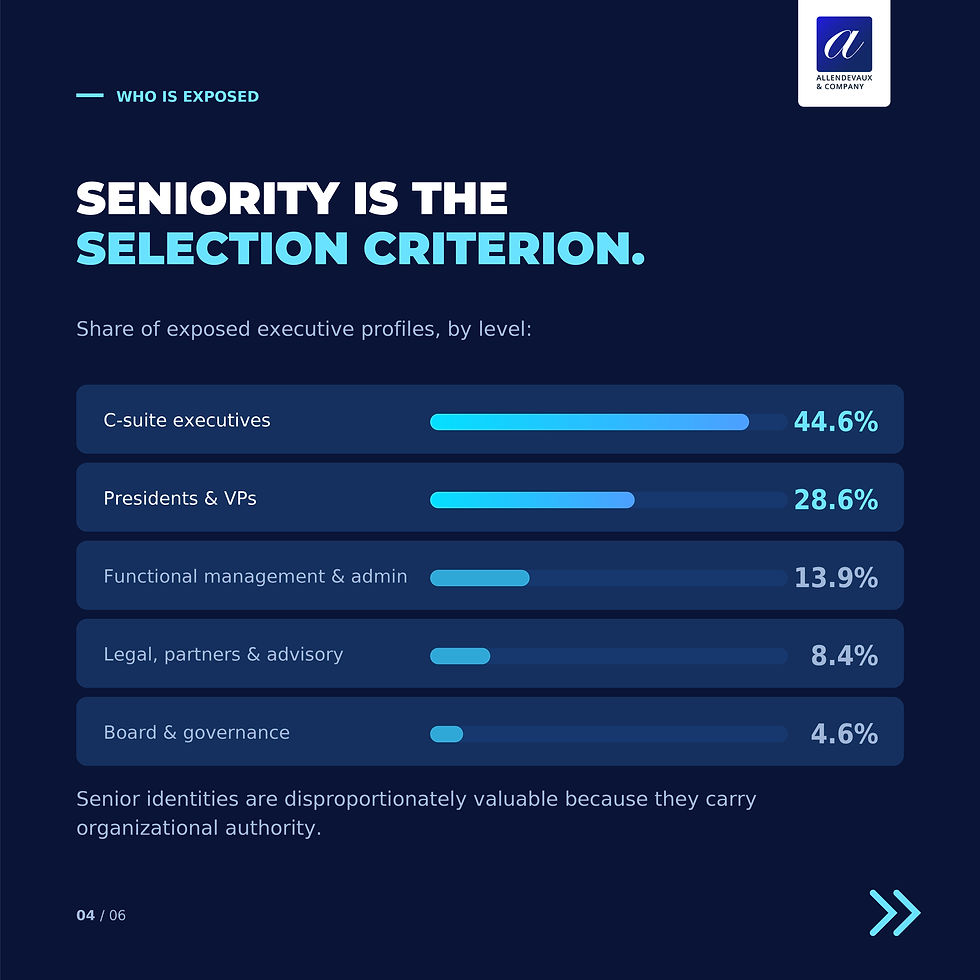
Exposed executive profiles skew sharply to the top of the organization: C-suite 44.6%, presidents and VPs 28.6%, functional management and administration 13.9%, legal, partners and advisory 8.4%, and board and governance 4.6%. Senior identities are worth more because they carry authority. An instruction from a CFO gets actioned; the same instruction from a junior employee gets questioned.
Identity data is reusable

A stolen password can be changed. A payment card can be cancelled. An SSN stays valuable. Combine it with name, date of birth, address, phone and employment history and you have a reusable fraud profile that works against banks, help desks, payroll providers and tax authorities, in any order, for as long as the details hold. The breach event ends. The exposure does not. It is also why credit monitoring on its own is a weak control: it reports misuse after the fact.
Security has to move upstream

Treat executive identity as something to monitor and reduce rather than clean up after an incident. Each step below narrows either the supply of usable data or the odds that an impersonation attempt lands:
1. Monitor executive exposure across illicit sources.
2. Validate whether leaked records actually belong to your protected personnel.
3. Reduce unnecessary public PII and data broker visibility.
4. Strengthen out-of-band checks for sensitive requests, particularly payments and credential resets.
5. Train the people attackers will impersonate, and the staff who act on their requests.
None of this prevents the next breach. It shortens the window in which a stolen identity can be turned against you.

Concerned about your leadership team's exposure? Allendevaux & Company helps organizations monitor executive identity exposure, validate what is real and reduce the public footprint attackers depend on. Contact our team, or email info@allendevaux.com.
Frequently asked questions
What is executive identity exposure?
Leaked or traded personal data about senior staff, such as SSNs, dates of birth, addresses and employment history, that can be used to impersonate them or defraud the organization.
Why is a stolen SSN worse than a stolen password?
A password can be reset and a card can be cancelled. An SSN is not easily reissued, so it keeps working as an identifier for years.
Why do attackers target executives specifically?
For their authority. Requests from senior leaders are questioned less often, which makes impersonating them more profitable than impersonating anyone else.
What is business email compromise?
Fraud in which an attacker impersonates a trusted party, usually an executive or supplier, to redirect a payment or extract sensitive data.
What can we do about data that has already leaked?
You cannot recall it. Monitor where it appears, confirm whether it relates to your people, reduce public PII and add out-of-band verification for sensitive requests.
Comments