

Cybersecurity Fast Facts 2026: 5 Trends Every Organization Needs to Know
Cybersecurity is changing at a pace that traditional security programs are struggling to match.
AI agents are moving into enterprise environments, vulnerability exploitation has become a leading route into organizations, and attackers are increasingly using generative AI to strengthen their techniques.
At the same time, businesses are still struggling with basic security fundamentals such as vulnerability remediation and AI governance.
Here are 5 cybersecurity facts shaping the threat landscape in 2026.
1. 74% of Organizations Plan to Adopt Agentic AI

Agentic AI is quickly moving from experimentation to enterprise deployment.
According to the data presented in the supplied research, 74% of organizations plan to adopt agentic AI within the next two years.
But adoption is significantly ahead of governance.
Only 21% have a mature governance model for AI agents, while:
35% cannot shut down a rogue AI agent
36% have no formal agent deployment plan
This creates a significant security gap.
AI agents can interact with systems, access information, and perform actions with increasing levels of autonomy. Without appropriate governance, organizations may struggle to understand what an agent can access, who is responsible for it, or how to stop it when something goes wrong.
The takeaway: AI adoption without AI governance can quickly become an enterprise security risk.
2. 31% of Breaches Now Begin With Vulnerability Exploitation
One of the biggest changes in the current threat landscape is how attackers are gaining initial access.
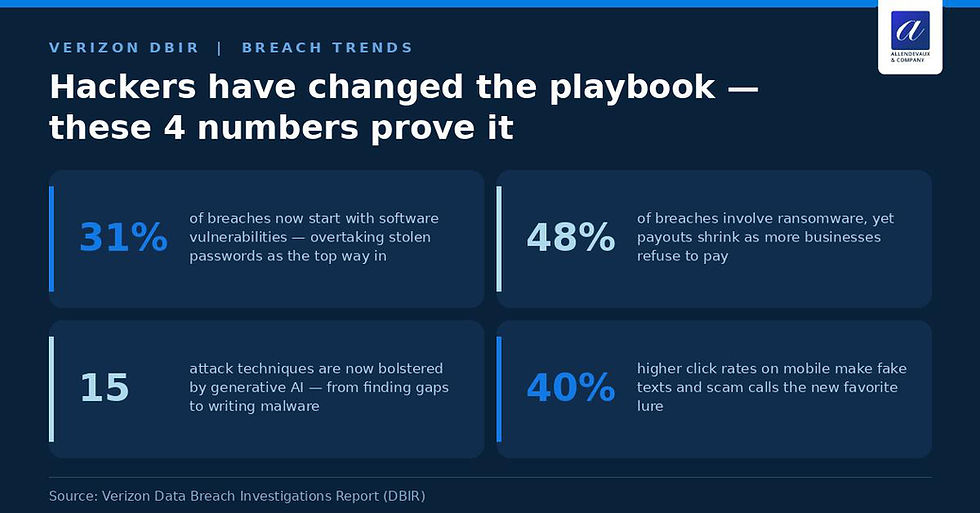
According to the supplied Verizon DBIR data, 31% of breaches now begin with the exploitation of software vulnerabilities, making it the leading initial access method shown in the data.
The problem becomes even clearer when looking at remediation:
Only 26% of critical CISA KEV vulnerabilities were fully fixed in 2025
Median time to fully resolve a critical vulnerability increased to 43 days
Organizations faced 50% more critical vulnerabilities to patch than the previous year
This creates a dangerous window for attackers.
A vulnerability doesn’t need to be unknown to be dangerous. If organizations know about a critical vulnerability but don’t remediate it quickly enough, attackers may have an opportunity to exploit it.
The takeaway: Vulnerability management needs to prioritize speed, exploitability, and business impact—not simply the number of open vulnerabilities.
3. 48% of Breaches Involve Ransomware
Ransomware continues to be one of the most significant threats facing organizations.
The supplied Verizon data shows that 48% of breaches involve ransomware, even as ransom payments decline because more organizations are refusing to pay.
This highlights an important evolution in ransomware.
The objective isn’t always simply to encrypt systems and demand payment.
Attackers can also use stolen information, operational disruption, and extortion to increase pressure on victims.
At the same time, generative AI is making attack operations more scalable, helping threat actors improve activities ranging from finding weaknesses to developing malicious code.
The takeaway: Organizations need resilience strategies that assume attackers may gain access—not just defenses designed to prevent every intrusion.
4. AI Is Becoming Part of the Attack Chain
Artificial intelligence isn’t just transforming legitimate businesses.
It’s changing how cybercriminals operate.
The supplied Verizon data indicates that attack techniques are increasingly being bolstered by generative AI, from finding security gaps to writing malware.
This means security teams are facing a difficult imbalance.
Attackers can use AI to accelerate reconnaissance, automate repetitive activities, create convincing social engineering content, and assist with malicious development.
Meanwhile, defenders need to secure increasingly complex environments while maintaining governance and compliance.
The takeaway: AI security and cybersecurity can no longer be treated as separate conversations.
Organizations need to understand both how AI can introduce new risks and how AI can strengthen defensive capabilities.
5. AI Will Reshape Cybersecurity Through 2030

The impact of AI on cybersecurity is expected to extend well beyond 2026.
The Gartner predictions presented in the supplied material highlight three major milestones:
By 2027
75% of regulated organizations will face fines exceeding 5% of global revenue from manual AI compliance processes.
By 2028
50% of cybersecurity incident-response efforts will be driven by AI applications.
By 2030
33% of IT work will be spent remediating AI data debt to secure AI.
These projections point toward a fundamental change in cybersecurity operations.
AI will increasingly become part of both sides of the security equation:
Attackers will use AI to increase the speed and scale of attacks.
Defenders will use AI to increase the speed and scale of detection and response.
The organizations that succeed will need governance frameworks capable of keeping pace with both.
What These Cybersecurity Facts Tell Us
Taken together, these five facts reveal a larger trend.
Organizations are adopting AI faster than they are governing it.
Attackers are exploiting vulnerabilities faster than many organizations can remediate them.
And generative AI is accelerating capabilities on both sides of the cybersecurity battlefield.
The result is a cybersecurity environment where speed has become a security requirement.
Organizations should focus on:
Continuous vulnerability discovery and prioritization
Faster remediation of actively exploited vulnerabilities
Strong governance for autonomous AI agents
Clear ownership and shutdown mechanisms for AI systems
Continuous monitoring of AI-enabled environments
AI-assisted detection and incident response
Final Insight: 2026 Is the Year of the Security Gap
The biggest cybersecurity challenge isn’t simply the number of attacks.
It’s the gap between how quickly technology is being adopted and how quickly organizations can secure it.
AI agents are moving into enterprise environments.
Vulnerabilities are becoming increasingly attractive entry points.
Attackers are adopting generative AI.
And traditional governance and remediation processes are struggling to keep up.
The message from these 2026 cybersecurity facts is clear:
Organizations don’t just need to become more secure. They need to become faster at securing what they deploy.
Because in the modern threat landscape, the gap between adoption and security is where attackers find their opportunity.



Comments